Our first carbon footprint: what we found at Dod Mill
5 May 2026A few weeks ago, for the first time, we sat down and properly measured the carbon footprint of Dod Mill. This is something we have been wanting to do for a while, but as a very small business, the process had felt a little daunting, and we weren’t sure we’d know what to do with the answer. But we did it, and it turned out to be one of the most rewarding and useful things we have done for the business.
This post shares what we found, and what we are planning to do about it.
How we did it
We used the SME Climate Hub Advanced Business Carbon Calculator, working through the process as part of Edinburgh University’s Climate Springboard programme, supported by South of Scotland Enterprise. The baseline year is our 2024/25 financial year. We included Scope 1 emissions (direct fuel use), Scope 2 (electricity) and the Scope 3 categories most relevant to a business like ours: the things we buy, the waste we generate, how our team travels and, most significantly, how our guests travel to us.
What we found
Our total footprint for 2024/25 was 25.8 tonnes of CO₂e on a market-based basis. To give that some context, the average UK household produces around 6 tonnes per year (heating, electricity, transport and waste only) so we are roughly equivalent to four households. For a business with four holiday properties, an events studio and five acres of grounds, that feels like a reasonable starting point, but it was interesting to dig into the detail of where this comes from.
The breakdown of carbon emissions at Dod Mill tells a clear story. Guest travel accounts for around 74% of our footprint. The distances people drive or fly to reach us in the Scottish Borders dwarf everything else we do. Our electricity use, our waste, the products we buy for the properties: all of those things matter, but they are relatively small compared with the journey each guest makes to get here. In fact, if you strip out the guest travel emissions at Dod Mill, our footprint is just 6.7 tonnes of CO₂e per year, around the same as one UK household produces from its heating, electricity, transport and waste alone.
The other significant finding was a positive one. We have two electricity accounts across the business and both are on 100% renewable green tariffs, backed by Scottish Power’s own UK windfarms. Under market-based carbon accounting, this brings our electricity emissions to zero. That is not creative accounting: it reflects an intentional purchasing decision, and it is a real credential. The Fishing Hut goes further still, running entirely off-grid on its own solar installation.
The guest travel problem
The honest truth is that there is no easy fix for guest travel. Dod Mill is in a rural location four miles from the nearest village and forty minutes from Edinburgh. There is no public bus. There is no railway station nearby. The vast majority of our guests arrive by car, and that is unlikely to change in the near future.
What will change is the cars themselves. UK legislation now requires that no new petrol or diesel cars are sold after 2030, with all new cars zero emission by 2035. By the time we reach our 2040 target, most of the cars on UK roads will be electric. If 80% of domestic visitor journeys are made by EV in 2040, our visitor travel emissions fall from 19 tonnes to around 5.5 tonnes. That is the single biggest lever available to us, and it is largely in the hands of legislation and the vehicle market rather than in ours.
What we can control is making EV travel to Dod Mill as straightforward as possible. We already have a charger on site. We are investigating additional guest charging capacity, with plans to have it in place by 2028.
What we are already doing
Beyond the electricity, there is quite a lot already in place. The management of our meadows, the apple juice we press from our orchard, the firewood from our own trees and from Hillhouse Farm seven miles away, the pallet kitchens made by a local joiner, the eight-year-old bed linen still going strong: all of these things reflect a way of running the business that we arrived at through practicality and values rather than a sustainability framework.
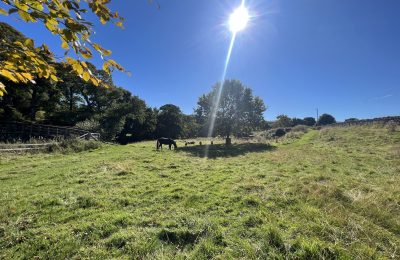
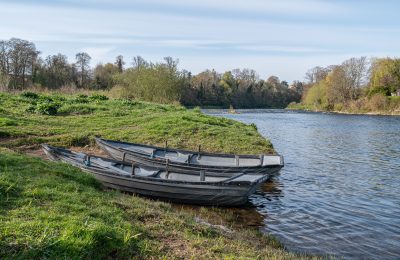
On the land, we have been carrying out significant riparian planting along the Boondreigh Water, fencing off a previously grazed section of riverbank and establishing willow and alder. A biodiversity assessment in September 2025 confirmed seven distinct habitat types on the site, including MG5 neutral grassland that has declined by over 95% across the UK, breeding dippers and otters, and three red-listed bird species. That is not something we created: it is something we have been quietly maintaining for years.
What we are working towards
Our target is a 90% reduction in emissions by 2040, five years ahead of Scotland’s national target of 2045. The actions that will get us there include:
- Establishing a composting system for food, garden and organic waste (planned for 2026 to 2027)
- Investigating solar PV expansion and a potential micro-hydro scheme using the existing mill lade
- Replacing Ruth’s diesel car with an electric vehicle
- Commissioning a professional ecological survey to give us a robust biodiversity baseline to measure against
- Installing additional EV charging for guests by 2028
Any residual emissions we cannot eliminate we intend to offset through surplus renewable energy exported to the grid from solar, hydro or wind generated on the Dod Mill site itself. That feels like a more responsible approach than purchasing carbon credits elsewhere.
A note on what this process felt like
I will be honest: completing a carbon footprint was not the most natural thing in the world for a small hospitality business to do. The methodology is genuinely complex, some of the numbers involve real uncertainty, and there are moments when you are choosing between imperfect options and hoping you are making the right call. The Edinburgh University Climate Springboard programme was completely invaluable in helping us navigate our way through it all.
The process of going through it was valuable in itself. It forced us to think carefully about what actually drives our impact, rather than making assumptions. The answer, in our case, is guest travel: everything else is a rounding error by comparison. That clarity changes how we think about our priorities.
We have published our full Sustainability Action Plan, which covers the complete carbon footprint, our biodiversity strategy, our circular economy approach and our climate resilience planning. It is available to download as a short summary and as a full document. We intend to update it annually as our measurement improves and our actions progress.